
When we talk about preparing kids for the future, we often focus on what they need to know. But increasingly, success depends less on memorizing facts and more on how children think. Critical thinking, the ability to analyze, evaluate, and reason through problems, has become one of the most valuable skills a child can develop. STEM education offers one of the most effective pathways for building these skills through hands-on experiments, coding challenges, and engineering projects that cultivate thoughtful, analytical thinking.
What Are Critical Thinking Skills for Kids?
Critical thinking means looking at information carefully and thinking it through before making decisions or forming opinions. For kids, it’s about asking good questions, figuring out how things work, and solving problems in thoughtful ways.
The key components include analysis (breaking problems into parts), evaluation (judging information quality), reasoning (making logical connections), and problem-solving (finding effective solutions). These skills help children navigate everything from schoolwork to friendships to everyday challenges.
Critical thinking matters more than memorization because facts can be looked up, but the ability to use information wisely can’t. It’s also important to understand that critical thinking differs from general intelligence; these are learned abilities that improve with practice, not fixed traits.

Why Critical Thinking Skills Matter for Children’s Development
Strong critical thinking skills create advantages across every area of a child’s life. Academically, these skills improve performance not just in STEM subjects but across all areas. In daily life, critical thinking helps kids make better decisions, weigh options, and think through choices rather than acting impulsively.
The complex challenges children will face as adults will demand strong analytical and reasoning abilities. Critical thinking prepares them for problems we can’t yet anticipate while building independence and confidence. Children who can think through problems on their own develop self-sufficiency that grows their confidence.
Long-term, critical thinking translates directly to career and life success. Employers consistently rank critical thinking among the most valued abilities, regardless of industry.
The Connection Between STEM and Critical Thinking
STEM education and critical thinking fit together naturally because STEM disciplines require analytical thinking at every step. The scientific method itself provides a framework for critical thinking, observation, asking questions, forming hypotheses, testing ideas, and drawing evidence-based conclusions.
The engineering design process emphasizes iterative thinking, trying something, analyzing results, and refining the approach. This teaches children that thinking is an active, ongoing process. Hands-on learning develops deeper thinking skills because it requires active engagement rather than passive absorption.
How STEM Classes Teach Kids to Analyze and Evaluate
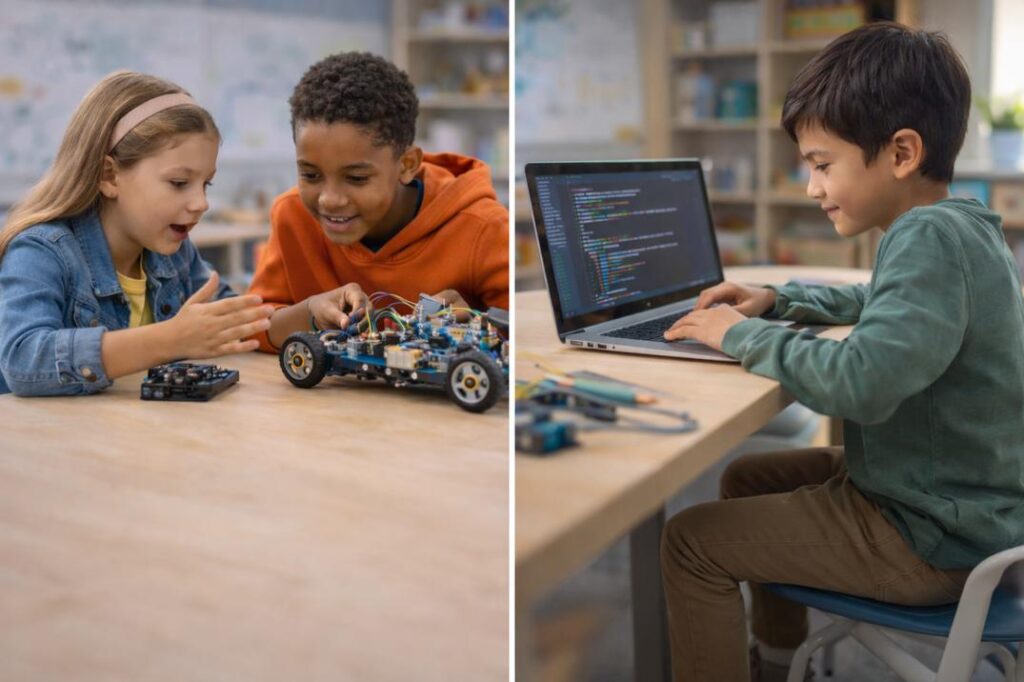
When faced with complex problems, children learn to break them into manageable parts. A complicated coding project becomes smaller functions. STEM activities naturally develop pattern recognition. Whether analyzing data, debugging code, or designing structures, children learn to identify relationships and connections. These classes also teach kids to distinguish between fact and opinion, evidence and assumption.
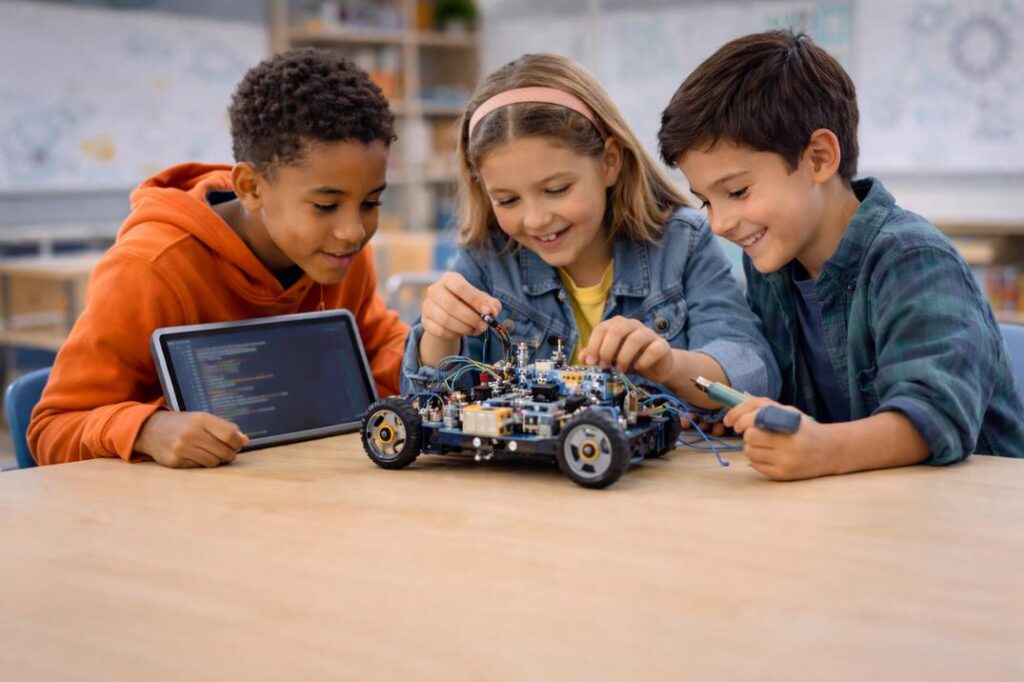
Evaluating evidence becomes second nature. When a robot doesn’t move as programmed or an experiment yields unexpected results, children must look at the evidence to understand why. They learn to base conclusions on what actually happened rather than what they hoped would happen.
Problem-Solving as Critical Thinking Practice
Every STEM challenge is essentially a problem-solving exercise. Children learn systematic approaches, defining problems, brainstorming solutions, implementing them, and evaluating results. Trial and error transforms something to avoid into valuable learning opportunities.
STEM problems typically have multiple solution pathways, teaching children that there’s rarely just one “right” way to approach challenges. Debugging and troubleshooting skills developed through coding and engineering apply broadly to all kinds of problems.
Logic and Reasoning Through STEM Activities
STEM education builds strong logical and reasoning skills through constant practice with cause-and-effect relationships. Coding particularly strengthens logical sequencing; programs must execute steps in the correct order to work properly.
If-then thinking becomes natural through programming and engineering. “If I build the structure this way, then it will support more weight.” This conditional reasoning applies to countless situations beyond STEM. Children also encounter both deductive reasoning (applying general principles) and inductive reasoning (deriving principles from observations).
Critical Thinking Skills Kids Develop in STEM Classes
STEM classes systematically develop multiple critical thinking skills that work together to create capable, thoughtful learners.
Critical Thinking Skills by STEM Activity
STEM Activity | Primary Skills Developed | Examples |
Coding & Programming | Logical sequencing, debugging, and pattern recognition | Breaking programs into functions, identifying errors |
Robotics | Cause-and-effect reasoning, iterative design, troubleshooting | Testing movements, adjusting sensors |
Science Experiments | Observation, hypothesis formation, evidence evaluation | Designing experiments, analyzing results |
Engineering Challenges | Constraint-based thinking, optimization, prototyping | Building under limitations, improving designs |
Observation Skills
STEM activities enhance observation because details matter. When conducting experiments, small changes significantly affect outcomes. When programming, a single misplaced character can break code. This attention to detail transfers to how children process information in all contexts.
Analytical Thinking
Breaking down information becomes intuitive through STEM work. Whether analyzing why a structure collapsed or what patterns appear in experimental data, children develop strong analytical capabilities that help them understand complex situations throughout life.
Evidence-Based Reasoning
STEM education grounds children in evidence-based reasoning. They learn to base conclusions on what they observe, measure, and test rather than assumptions. This empirical approach builds habits of thought that serve them well in an information-rich world.
Critical Thinking Skills for Kids at SmartKidsUniversity
SmartKidsUniversity integrates critical thinking development into every program. In coding classes, children develop logical thinking through algorithm design, debugging, and systematic problem-solving. Robotics programs require students to think about how systems integrate, analyzing inputs and troubleshooting when robots don’t behave as expected.
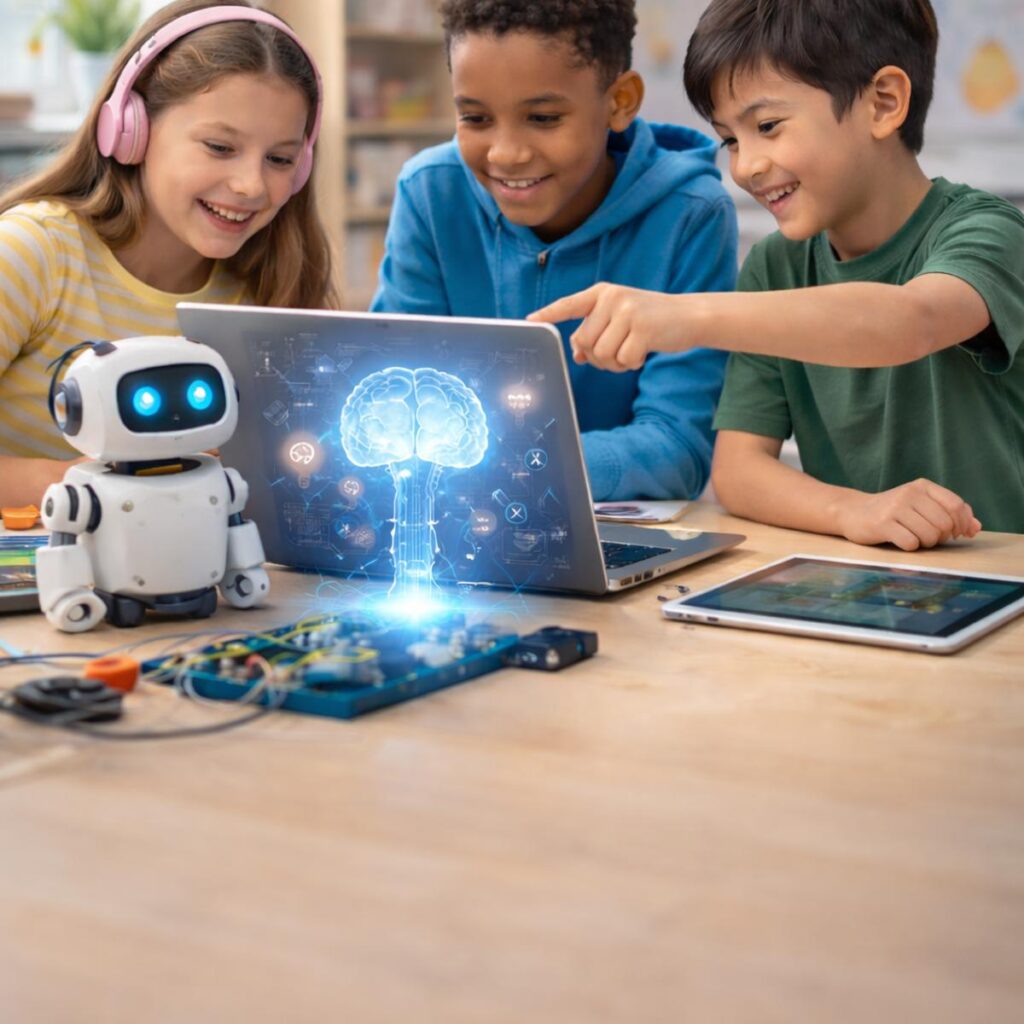
AI and machine learning classes introduce students to how intelligent systems analyze patterns and make decisions, strengthening their own analytical thinking. Natural Sciences Classes ground critical thinking in the scientific method; students form hypotheses, design experiments, and draw evidence-based conclusions. Social Sciences Classes develop critical thinking about human behavior and complex societal questions.
Project-based learning ensures students actively engage in critical thinking rather than passively receiving information. Instructors guide development by asking probing questions rather than simply providing answers. Age-appropriate challenges ensure children work at their optimal learning edge, where critical thinking skills actively develop.