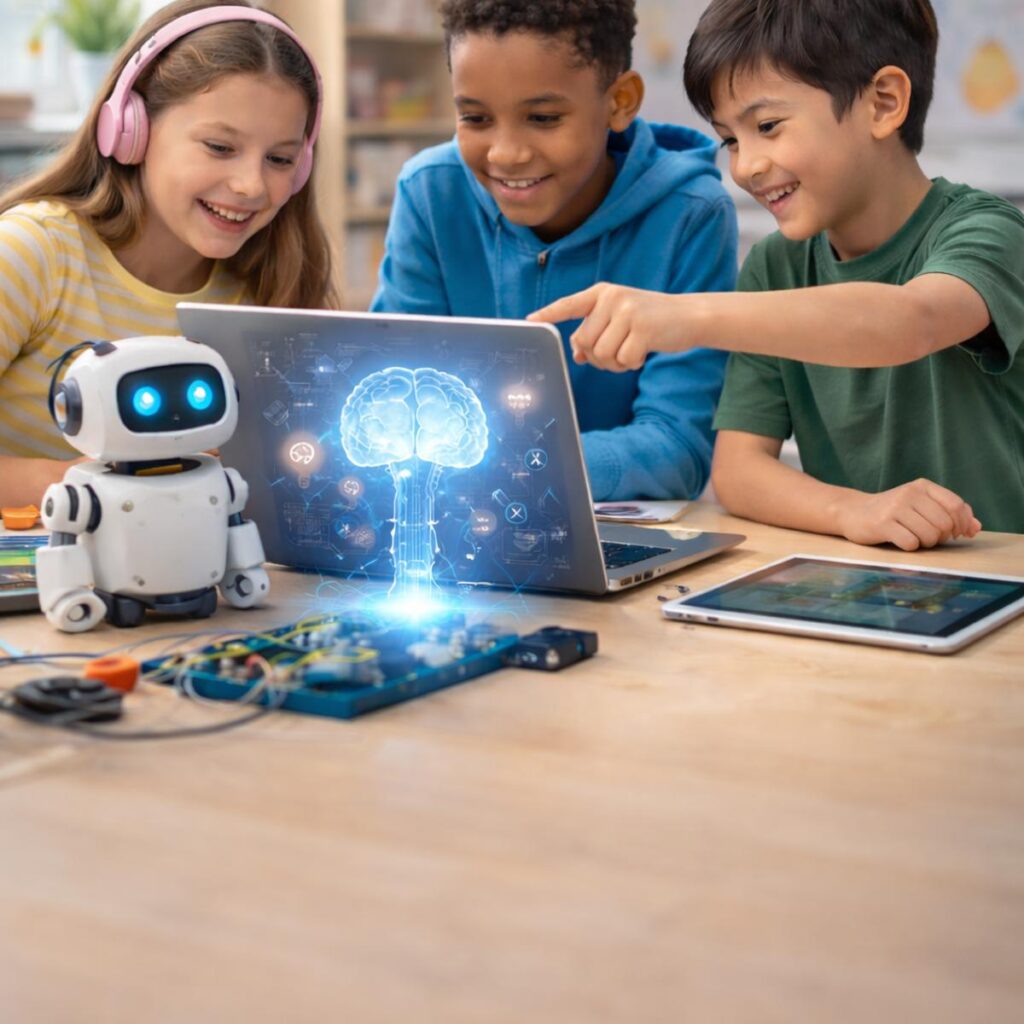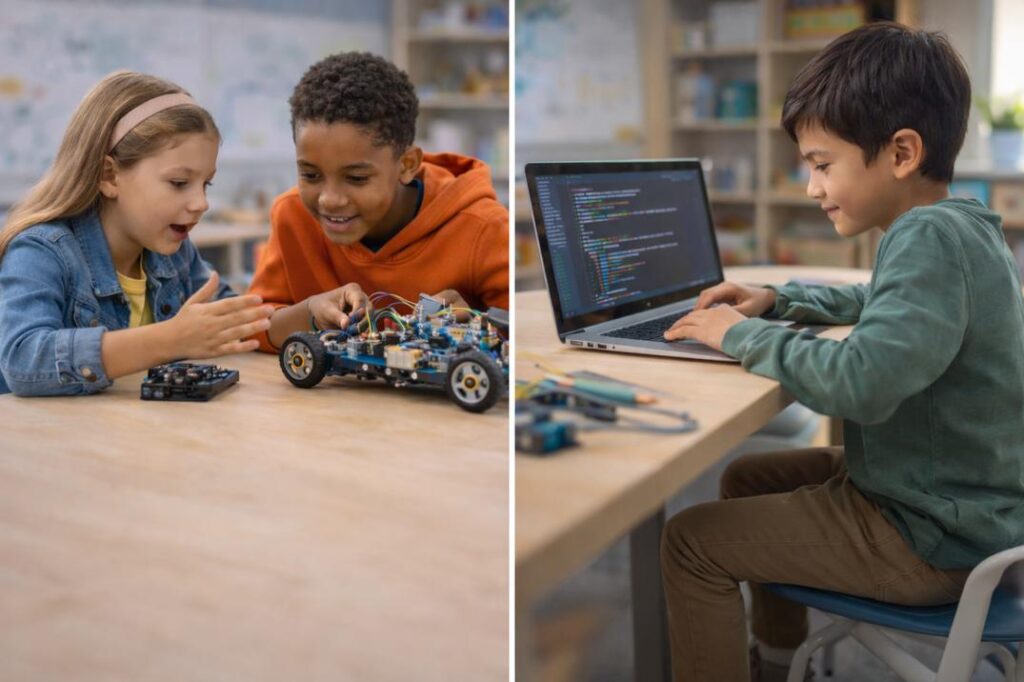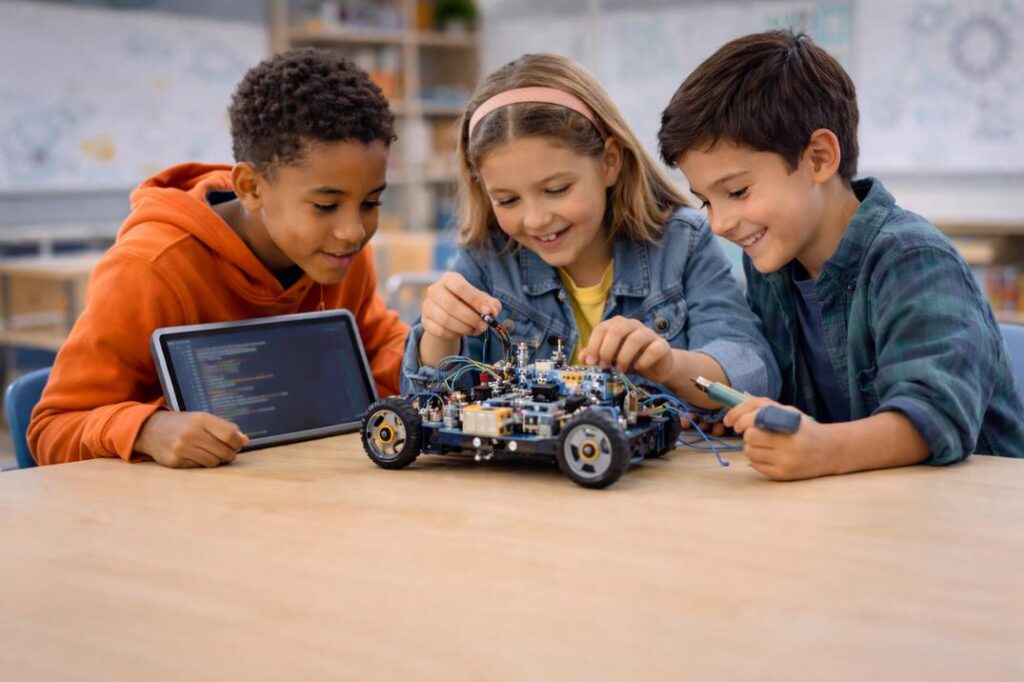

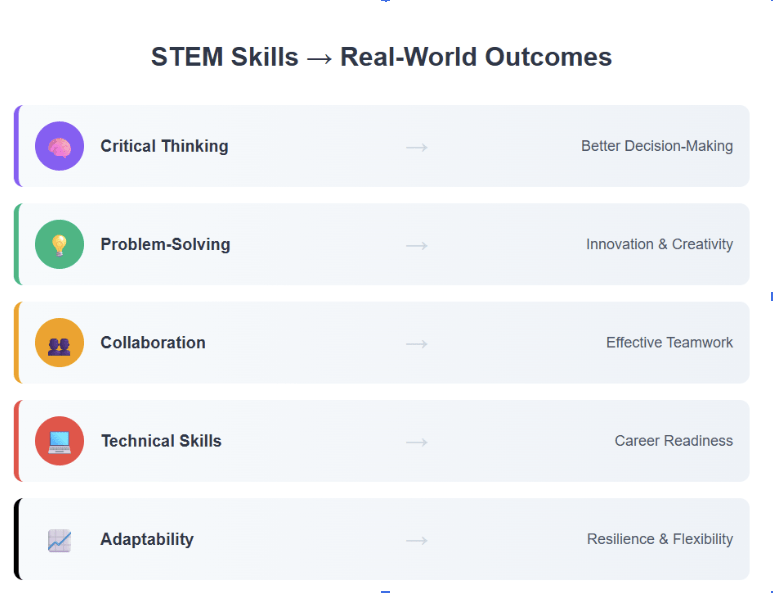
The world our children are growing up in looks fundamentally different from the one we knew. Technology shapes nearly every aspect of modern life, and in this rapidly evolving landscape, STEM education has become one of the most valuable investments parents can make. STEM programs for kids do more than teach science and math, they develop critical thinking, problem-solving abilities, and adaptability that children will use throughout their lives.
What Are STEM Programs for Kids?
STEM stands for Science, Technology, Engineering, and Mathematics. But STEM programs for kids bring these disciplines together in a way that mirrors real life, where problems rarely fit neatly into a single subject area.
STEM activities vary widely depending on age and skill level. Younger children might explore basic coding through visual programming or conduct simple science experiments. Older students tackle more complex challenges like building autonomous robots or developing AI applications. These programs are accessible starting in elementary school and continuing through high school, with the key being age-appropriate challenges that push children to grow.
Key Benefits of STEM Programs for Kids
The benefits of STEM programs for kids extend far beyond classroom performance. Cognitively, STEM education strengthens analytical thinking, logical reasoning, and pattern recognition. Socially, these programs emphasize collaboration and communication; working on team projects teaches children how to share ideas and contribute to collective goals.
Practically, STEM learning translates directly to real competence in the future. The problem-solving frameworks children develop and the comfort they gain with technology prepare them for an increasingly technical world. Long-term, students with strong STEM foundations perform better academically, develop greater confidence, and open doors to career opportunities. Perhaps most importantly, they develop a mindset that embraces learning as an ongoing, rewarding process.
How STEM Education Develops Critical Thinking Skills
Critical thinking in STEM means analyzing information objectively, questioning assumptions, and drawing logical conclusions. STEM activities naturally encourage this because they constantly ask children to figure things out rather than accept answers. When a robot doesn’t move as expected, students must analyze why. When code doesn’t run properly, they systematically debug to find the error.
Building Problem-Solving Abilities Through STEM Programs
Every STEM project presents challenges that require methodical solutions. Students learn to define problems clearly, break them into smaller components, develop potential solutions, test them, and refine them based on results. This framework applies far beyond STEM, it’s how effective problem-solvers approach challenges in any domain.
Trial and error play a crucial role. In STEM programs, failure isn’t something to avoid; it’s valuable information. When a prototype doesn’t work, or an experiment yields unexpected results, students learn to treat these outcomes as data points guiding their next attempt. This builds resilience that extends to all areas of life.
STEM Programs Foster Creativity and Innovation
There’s a misconception that STEM is all about rigid logic with no room for creativity. The reality is quite the opposite. When children design robots, they make creative decisions about form and function. When they code games, they imagine experiences and bring them to life. When they tackle engineering challenges, they develop original solutions nobody showed them.
Several students might receive the same robotics challenge, but each will likely design a different solution based on their creative approach. One might prioritize speed, another stability, another aesthetic design. All apply STEM principles, but creativity drives their unique implementations. This intersection of creativity and technical skill is why STEAM education, adding Arts to STEM, continues to grow in recognition.
Developing Adaptability and Growth Mindset
STEM education teaches children to embrace challenges and learn from setbacks. When students work on iterative projects, building, testing, revising, and testing again, they develop resilience. They learn that initial attempts rarely produce perfect results and that improvement comes through persistent refinement.
STEM also helps children adapt to new technologies and changing environments. More important than mastering any particular technology is developing the confidence and learning strategies to adapt to new ones as they emerge. This adaptability extends beyond technology, the curiosity, persistence, and willingness to experiment that STEM programs cultivate serve students well whenever they encounter unfamiliar situations.
Collaboration and Communication in STEM Learning
Most significant STEM work happens through collaboration, and quality programs reflect this by emphasizing teamwork alongside technical skills. Working on projects with peers teaches children how to contribute to group efforts and integrate different strengths toward common goals. A robotics team might include children who excel at mechanical design, strong programmers, and effective planners.
Communication is equally important. Being able to explain technical concepts clearly is a critical skill that STEM programs help develop. Students learn that technical knowledge has limited value if it can’t be effectively shared with teammates, instructors, or audiences.
Choosing the Right STEM Program for Your Child
Quality STEM programs prioritize hands-on, project-based learning over passive instruction. Children should be building, experimenting, and creating, not just watching demonstrations. The best programs balance structured guidance with opportunities for creative exploration.
Age-appropriate content and challenge levels matter tremendously. Programs should meet children where they are developmentally, while still pushing them to grow. Look for programs that assess individual skill levels and adapt accordingly.
Instructor qualifications significantly impact program quality. Effective STEM instructors need both subject expertise and the ability to engage children, foster curiosity, and guide without dictating solutions.
STEM Programs for Kids at SmartKidsUniversity
SmartKidsUniversity builds its STEM education around developing the thinking, learning, and adaptation skills children need for future success. Rather than treating STEM subjects as isolated topics, programs integrate science classes, technology, engineering, and mathematics through engaging, real-world projects.
The curriculum spans coding and robotics, AI and machine learning, and engineering and design challenges. SmartKidsUniversity’s project-based learning methodology puts children in active roles where they design solutions, build prototypes, test ideas, and refine their work based on results.
Qualified instructors create supportive environments where children feel comfortable experimenting, asking questions, and learning from mistakes. Instruction is personalized based on individual skill levels and interests, ensuring each child receives appropriate challenges and support. Programs are designed to be accessible and engaging regardless of prior STEM experience.
Why STEM Skills Matter for Future Success
The job market children entering school today will eventually face looks dramatically different from the one their parents knew. Career readiness requires the ability to learn continuously, adapt to new tools, and solve problems that don’t yet have established solutions. STEM programs build precisely these capabilities.
Importantly, STEM skills benefit children regardless of their eventual career paths. While STEM education prepares students for careers in science and technology, the thinking skills it develops prove valuable in virtually every field. Doctors, lawyers, business leaders, artists, and educators all benefit from strong analytical thinking and comfort with technology.
STEM Skills Across Different Fields
STEM Skill | Healthcare | Business | Creative Arts | Education |
Problem-Solving | Treatment planning | Strategic planning | Creative solutions | Curriculum design |
Critical Thinking | Evidence-based medicine | Data-driven decisions | Artistic evaluation | Assessment design |
Adaptability | New treatments | Market changes | Evolving techniques | New educational tools |
Frequently Asked Questions
At what age should kids start STEM programs? Children can begin STEM learning as early as elementary school with age-appropriate activities that build foundational skills and confidence.
What’s the difference between STEM and regular science classes? STEM programs integrate multiple disciplines through hands-on projects and real-world problem-solving, while traditional classes typically focus on one subject through more passive methods.