
Parents exploring STEM education often face the same question: should children start with robotics or coding? Both are popular, both are valuable, and both promise to build problem-solving skills. The challenge is understanding how they differ and which approach best supports the way a child thinks and learns. The answer is not about choosing a “better” option. Robotics and coding develop problem-solving in different ways. Understanding those differences helps parents make a more confident, informed decision.
Why Problem-Solving Skills Matter More Than the Tool
Problem-solving is one of the most important skills children can develop. It supports academic learning, decision-making, creativity, and resilience. While robotics and coding are tools used to teach these skills, the real value lies in how children learn to approach challenges, analyze situations, and adapt when something doesn’t work.
These same habits of thinking extend beyond technology. In AI classes, children explore how algorithms make decisions and learn to analyze patterns. In natural science classes, they test hypotheses and interpret results. In social science classes, they examine systems, relationships, and cause-and-effect patterns in human behavior.
Focusing on thinking processes rather than specific technologies ensures that skills remain useful even as tools and platforms change.
What Coding Teaches Children About Problem-Solving
Coding introduces children to structured, logical thinking. They learn to break problems into smaller steps, sequence actions, and predict outcomes. When code doesn’t work as expected, children debug by reviewing their logic, identifying errors, and testing alternative solutions.
This process strengthens abstract reasoning and helps children develop patience and attention to detail. Coding is especially effective for children who enjoy puzzles, patterns, and clear cause-and-effect relationships.
What Robotics Teaches Children About Problem-Solving
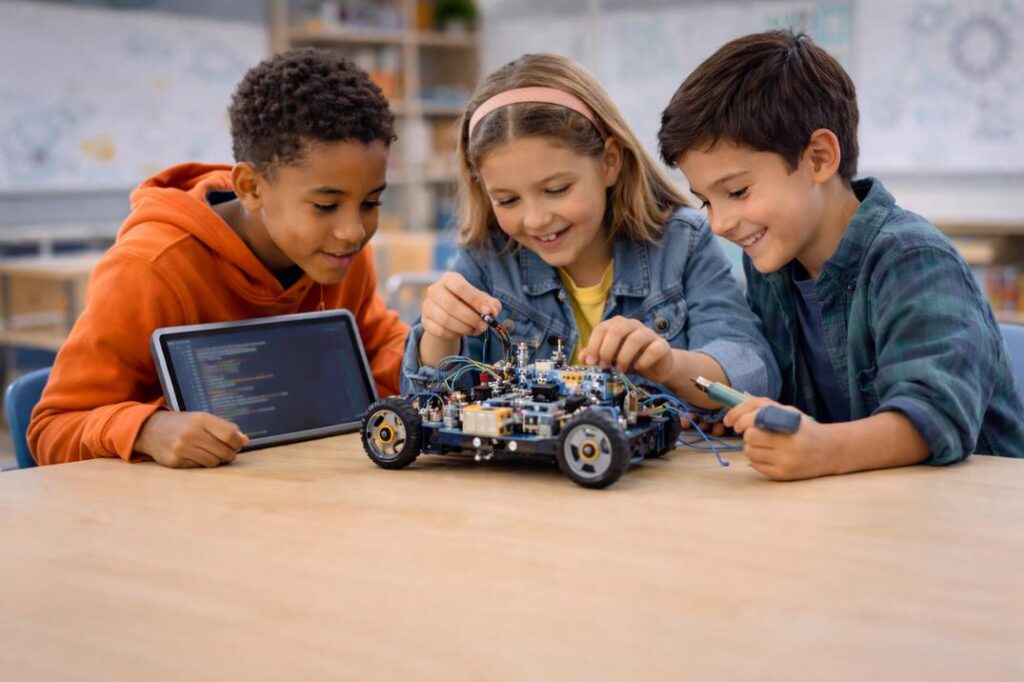
Robotics connects problem-solving to the physical world. Children design, build, and test systems that move, respond, and interact with their environment. When something fails, the reason is often visible, which encourages investigation and hands-on adjustment.
Through robotics, children develop systems thinking, spatial reasoning, and an understanding of how multiple variables interact. The learning experience is active and tangible, making problem-solving feel concrete and meaningful.
Key Differences Between Robotics and Coding for Kids
Coding focuses on abstract problem-solving, where children work within digital environments and think primarily in sequences and logic. Robotics adds a physical layer, requiring children to consider mechanics, space, timing, and real-world constraints.
Feedback in coding usually comes through messages or outcomes on a screen, while feedback in robotics is immediate and visible in how a system behaves. These differences mean each approach appeals to different learning styles and strengths.
Which Builds Stronger Problem-Solving Skills?
Neither robotics nor coding is inherently stronger. Coding excels at building logical, analytical problem-solving skills, while robotics strengthens applied and systems-based problem-solving. Both approaches teach children how to think through challenges, but from different perspectives. The strongest problem-solvers often experience both, allowing them to connect abstract logic with real-world application.
Which Is Better for Different Types of Learners?
Children who enjoy structured challenges, patterns, and working through logic step by step often connect naturally with coding. Children who prefer hands-on exploration, experimentation, and visible outcomes may find robotics more engaging.
Gifted learners frequently benefit from open-ended challenges offered by both disciplines. The key is allowing children to explore in ways that match their curiosity rather than forcing a single path.
Why Combining Robotics and Coding Is Often Most Effective
When robotics and coding are combined, children see how abstract instructions translate into real-world action. Coding provides the structure, while robotics brings those structures to life.
This combination reinforces understanding, strengthens problem-solving skills, and helps children transfer learning across contexts. Rather than competing, robotics and coding complement each other.
How Smart Kids University Approaches Robotics and Coding
At Universidad Smart Kids, robotics and coding are used as tools to support deeper thinking rather than as isolated skills. Children are guided to explore challenges, test ideas, and reflect on outcomes, with human mentors supporting their learning process.
The focus is on building confidence, curiosity, and flexible problem-solving abilities. By integrating robotics and coding thoughtfully, Smart Kids University helps children connect logical reasoning with real-world systems while learning at their own pace.
How Parents Can Choose the Right Starting Point
Parents can start by observing how their child approaches challenges. Some children enjoy working through problems quietly and methodically, while others prefer building, testing, and adjusting. Choosing programs that emphasize thinking, exploration, and guidance over speed or performance ensures a positive learning experience. The goal is not to choose the “right” tool, but to support how a child learns best.
Final Thoughts: It’s Not Robotics vs Coding, It’s How Children Learn
Robotics and coding both play valuable roles in developing problem-solving skills. Each strengthens a different way of thinking, and together they create a more complete learning experience.
When parents focus on curiosity, process, and thoughtful guidance, children gain skills that extend far beyond technology. The most important outcome is not mastery of a tool, but the ability to approach challenges with confidence and clarity.
Preguntas frecuentes
At what age can children start robotics or coding?
Many children can begin basic coding or robotics activities as early as ages 5–7 when programs are designed for developmental readiness. Early programs focus on sequencing, logic, and simple cause-and-effect rather than complex syntax or engineering concepts.
Does a child need their own computer or robotics kit to get started?
Not necessarily. Many structured programs provide all the required equipment during classes. For beginners, guided access to tools is often more beneficial than independent use at home without direction.
How much time per week should children spend on robotics or coding?
Consistency matters more than intensity. One to two structured sessions per week is often enough to build steady progress without overwhelming a child. The focus should be on depth of engagement rather than hours spent.
Can robotics or coding improve a child’s confidence?
Yes. When children solve challenges independently, debug mistakes, or see a project come to life, they experience a sense of accomplishment. This builds confidence in their ability to tackle unfamiliar problems.